

Owners Corporation Budgets and Levies in Victoria: How They Are Set
What owners corporation fees actually pay for
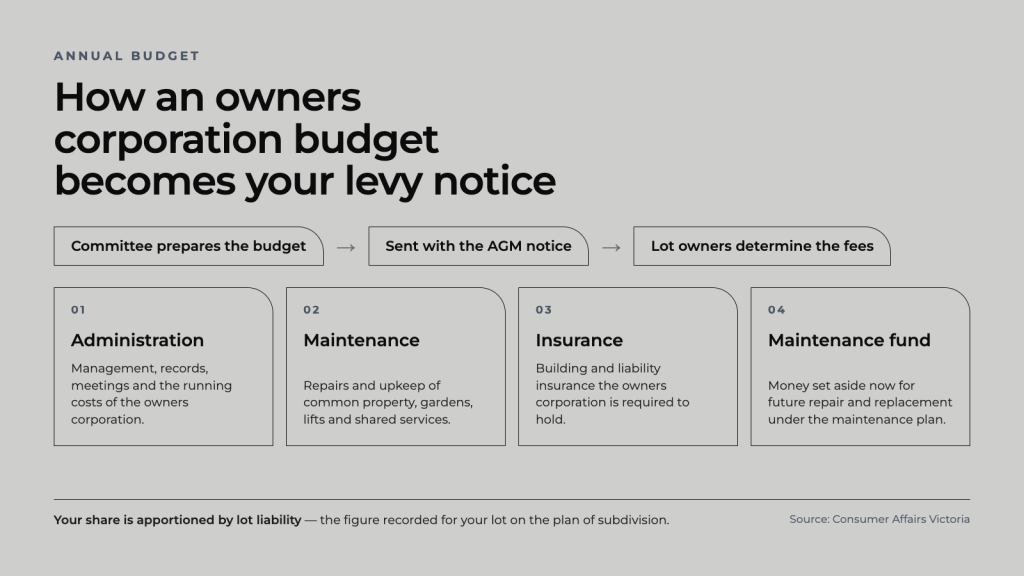
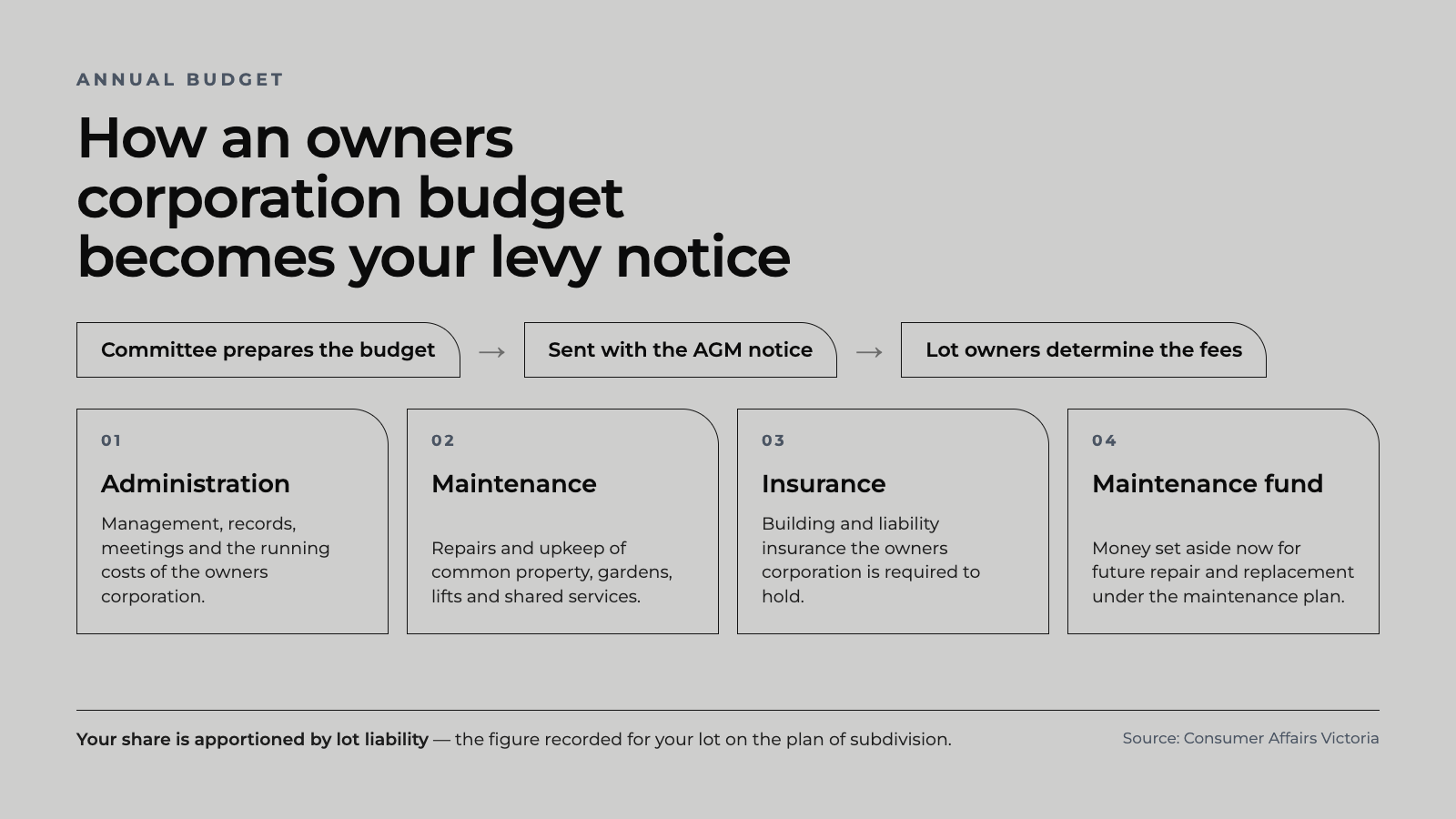
Owners corporation fees — levies — fund the annual budget the owners corporation approves: administration, maintenance of common property, insurance and, where there is a maintenance plan, a contribution to the maintenance fund. Your share is calculated from your lot liability rather than from the size or value of your apartment, which is why two similar lots in the same building can receive different fee notices.
How the annual budget is prepared
Before each annual general meeting, the committee — or a delegate such as the owners corporation manager — estimates the cost of administration, maintenance, insurance and any contribution to the maintenance plan. That estimate is the proposed annual budget.
The owners corporation must send the proposed annual budget to lot owners with the notice of the annual general meeting. The budget is then put to that meeting, where lot owners determine the annual fees for the coming year. Sending it with the notice is what gives owners time to read the numbers before they vote on them.
A maintenance plan — the schedule of future works on common property — is what makes those estimates concrete, because a detailed plan tells the committee what is coming and roughly what it will cost.
How your share is worked out
Annual fees are apportioned by lot liability — the share of owners corporation expenses recorded for your lot on the plan of subdivision. Lot liability is set by the developer when the plan is registered and is not always proportional to apartment size, so it is the number to check first when a fee notice looks wrong.
Lot liability is not the same as lot entitlement. Entitlement is your share of ownership of the common property and it drives voting rights; liability is what you pay. Changing either of them requires a unanimous resolution.
Annual fees and special fees
Annual fees cover the ongoing costs in the budget. Special fees cover extraordinary or unexpected expenditure — an urgent building repair, or the cost of defending legal action against the owners corporation.
One threshold is worth knowing: if the proposed special fees are more than double the owners corporation’s current annual fees, the decision needs a special resolution — support from at least 75% of lot owners or lot entitlements, depending on whether the vote is taken by poll or ballot or in person.
Special fees are also apportioned by lot liability, unless the works will only or substantially benefit some lots. In that case the benefit principle applies: those who benefit more pay more. It does not have to be applied exactly, only reasonably, and it may make no difference at all where the owners who benefit most already pay higher annual fees.
The maintenance fund
Any owners corporation with a maintenance plan must have a maintenance fund. It holds the part of the annual fees designated for the maintenance plan, any insurance payout received for an item in that plan, and interest earned on the fund.
How money leaves the fund depends on the work. An ordinary resolution at a general meeting covers items listed in the maintenance plan, while an urgent matter that is not in the plan requires a special resolution. The owners corporation decides what proportion of annual fees is contributed to the fund, how it is paid and when payment is due — usually quarterly.
Fee notices, due dates and late payment
Fees become payable when the owners corporation gives notice in the approved form: a fee notice, and a final fee notice where fees remain unpaid. The approved forms matter — without them an owners corporation can have difficulty recovering the money.
The first fee notice must state that the lot owner has to pay the fees and charges within 28 days of the date of the notice. The owners corporation also has the power to charge penalty interest on unpaid fees, and Consumer Affairs Victoria sets out payment plans and financial hardship options for owners who cannot pay on time.
Disputes about fees are decided by VCAT, which can make binding orders — for example requiring an owners corporation to do works or change a decision.
Financial statements, auditing and records
The owners corporation must present its financial statements at every annual general meeting, summarising all transactions for the financial year — income, expenditure, assets and liabilities, and any penalty interest charged.
Owners corporations described in the regulations as prescribed must have those statements audited at the end of each financial year. Others can decide at the annual general meeting whether to audit, and Consumer Affairs Victoria recommends that all owners corporations have their accounts audited.
Records matter for the same reason. An owners corporation must keep records covering all of its income, expenditure, assets and liabilities, as well as its register, which records each lot’s liability and entitlement. Where records are kept on a system owned by a third party such as the manager, the committee and lot owners can inspect them free of charge and take copies for a reasonable fee.
A short checklist for committees
- Start the budget early — insurance premiums, contract renewals and maintenance plan works all need to be priced before the AGM.
- Send the proposed budget out with the AGM notice, not at the meeting.
- Keep the maintenance fund contribution visible in the budget rather than treating it as whatever is left over.
- Check lot liabilities on the plan of subdivision before fee notices are issued, not after an owner queries theirs.
- Put any special fee above twice the current annual fees to a special resolution.
Where this fits in the bigger picture
Budgets and levies are one half of running an owners corporation; the other half is how the building is managed day to day. Our owners corporation management services cover the budget, the levy cycle, insurance, maintenance and committee support, and the resources page collects the guides and templates committees ask for most.
If your committee is considering a change of manager — the point at which budgets and records usually get a hard look — the sequence is set out on our OC transition page. Comparing management fees, rather than the levies owners pay, is a different cost with its own guide: owners corporation management fees explained.
Sources
- Consumer Affairs Victoria – Fees
- Consumer Affairs Victoria – Financial management
- Consumer Affairs Victoria – Maintenance fund
- Consumer Affairs Victoria – Record keeping
- Consumer Affairs Victoria – Owners corporations definitions
- Owners Corporations Act 2006 (Vic) – Victorian legislation
General information about Victorian owners corporation practice, not legal or financial advice. Requirements and figures are as published by Consumer Affairs Victoria; confirm the current position for your owners corporation.